
  • Schools and departments
  • Henley Business School
  • University of Reading Malaysia
  • Applicants
  • Student
  • Staff
  • Alumni
  • Local Community
Show/Hide navigation
University of Reading University of Reading
Mobile search categories
  • Study and life
  • Research
  • About us
  • Contact us
  • View courses
  • Home
  • Study and life
    • Study
    • Student life
    • Accommodation
    • Open Days and visiting
    • International students
  • Research
    • Research themes
    • Impact
    • Innovation and partnerships
    • Research environment
    • Get involved
  • About us
    • Business
    • Our global community
    • Local community
    • Visit us
    • Strategy
    • Governance
  • Contact us
  • Applicants
  • Student
  • Staff
  • Alumni
  • Local Community
  • Schools and departments
  • Henley Business School
  • University of Reading Malaysia
  • View courses

Early primates survived in cold, not tropical climates

06 August 2025
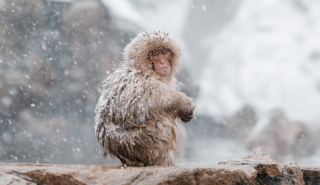
A cold monkey

Primates - the group of animals that includes monkeys, apes and humans - first evolved in cold, seasonal climates around 66 million years ago, not in the warm tropical forests scientists previously believed.

Researchers from the University of Reading used statistical modelling and fossil data to reconstruct ancient environments and trace where the common ancestors of all modern primates lived. 

The study, published today (Tuesday, 5 August) in the journal PNAS, says these first primates most likely lived in North America in a cold climate with hot summers and freezing winters, overturning the long-held "warm tropical forest hypothesis" that has long influenced evolutionary biology.

Dr Jorge Avaria-Llautureo, lead author at the University of Reading, said: "For decades, the idea that primates evolved in warm, tropical forests has gone unquestioned. Our findings flip that narrative entirely. It turns out primates didn't emerge from lush jungles - they came from cold, seasonal environments in the northern hemisphere.

“Understanding how ancient primates survived climate change helps us think about how living species might respond to modern climate change and environmental changes.”

Moving to survive

Primates that could travel far when their local weather changed quickly were better at surviving and having babies that lived to become new species. 

When primates moved to completely different, more stable climates, they travelled much further distances - about 561 kilometres on average compared to just 137 kilometres for those staying in similar, unstable climates. Early primates may have survived freezing winters by hibernating like bears do today - slowing down their heart rate and sleeping through the coldest months to save energy. Some small primates still do this - dwarf lemurs in Madagascar dig themselves underground and sleep for several months when it gets too cold, protecting themselves from freezing temperatures under layers of roots and leaves.

Primates didn't reach tropical forests until millions of years later. They started in cold places, then moved to mild climates, then to dry desert-like areas, and finally made it to the hot, wet jungles we see them in today. When local temperatures or rainfall changed quickly in any direction, primates were forced to find new homes, which helped create new species.

Püschel, T. A., Meade, A., Baker, J., Nicholson, S. L., & Venditti, C. (2025). The radiation and geographic expansion of primates through diverse climates. Proceedings of the National Academy of Sciences, 122(32), e2423833122. https://doi.org/10.1073/pnas.2423833122

Loading additional items please wait....

Main Menu


News from 2025

Contact the press team

Expert spokespeople

Media, demonstrations, and petitions on campus

Connecting Research Blog

Events

Media Enquiries


Journalists can contact the press office at any time.

+44 (0)118 378 5757 (24 hours)

pressoffice@reading.ac.uk

News Archives


News from 2025

News from 2024

News from 2023

News from 2022

News from 2021

News archive 1998-2020

mask
Choose a subject
2025/26
2026/27
Undergraduates
Postgraduates
Undergraduates
Postgraduates

Subjects A-B

  • Agriculture
  • Archaeology
  • Building and Surveying

Subjects C-E

  • Construction Management
  • Consumer Behaviour and Marketing
  • Economics

Subjects F-G

  • Finance
  • Food

Subjects H-M

  • International Foundation Programme (IFP)
  • International Relations
  • Museum Studies

Subjects N-T

  • Politics and International Relations
  • Surveying and Construction Management

Subjects A-C

  • Construction Management and Engineering

Subjects D-G

  • Energy and Environmental Engineering
  • Engineering
  • English Language and Applied Linguistics

Subjects H-P

  • Healthcare
  • Law
  • Linguistics
  • Pharmacy
  • Physician Associate
  • Project Management

Subjects A-B

  • Accounting
  • Acting and Drama
  • Agriculture
  • Ancient History
  • Anthropology
  • Archaeology
  • Architectural Engineering
  • Architecture
  • Art
  • Biochemistry
  • Biological Sciences
  • Biomedical Engineering
  • Biomedical Sciences
  • Bioveterinary Sciences
  • Building and Surveying
  • Business and Management

Subjects C-E

  • Chemistry
  • Classics and Classical Studies
  • Climate Science
  • Computer Science
  • Construction Management
  • Consumer Behaviour and Marketing
  • Creative Writing
  • Criminology
  • Ecology
  • Economics
  • Education
  • Engineering
  • English Language and Applied Linguistics
  • English Literature
  • Environment

Subjects F-G

  • Film & Television
  • Finance
  • Food
  • Foundation programmes
  • French
  • Geography
  • German
  • Graphic Communication and Design

Subjects H-M

  • Healthcare
  • History
  • International Development
  • International Foundation Pathways
  • International Relations
  • Italian
  • Languages and Cultures
  • Law
  • Linguistics
  • Marketing
  • Mathematics
  • Medical Sciences
  • Meteorology and Climate
  • Microbiology
  • Museum Studies

Subjects N-T

  • Nutrition
  • Pharmacology
  • Pharmacy
  • Philosophy
  • Physician Associate Studies
  • Politics and International Relations
  • Psychology
  • Real Estate and Planning
  • Sociology
  • Spanish
  • Speech and Language Therapy
  • Surveying and Construction Management
  • Teaching
  • Theatre & Performance

Subjects U-Z

  • Wildlife Conservation
  • Zoology

Subjects A-C

  • Accounting
  • Agriculture
  • Ancient History
  • Archaeology
  • Architecture
  • Artificial Intelligence
  • Art
  • Biological Sciences
  • Biomedical Sciences
  • Business (Post-Experience)
  • Business and Management (Pre-Experience)
  • Classics
  • Climate Science
  • Computer Science
  • Construction Management and Engineering
  • Consumer Behaviour
  • Creative Enterprise

Subjects D-G

  • Data Science
  • Dietetics
  • Digital Business
  • Ecology
  • Economics
  • Education
  • Energy and Environmental Engineering
  • Engineering
  • English Language and Applied Linguistics
  • English Literature
  • Environmental Sciences
  • Film, Theatre and Television
  • Finance
  • Food and Nutritional Sciences
  • Geography and Environmental Science
  • Graphic Design

Subjects H-P

  • Healthcare
  • History
  • Information Technology
  • International Development and Applied Economics
  • Law
  • Linguistics
  • Management
  • Marketing
  • Meteorology and Climate
  • Microbiology
  • Nutrition
  • Pharmacy
  • Philosophy
  • Physician Associate
  • Politics and International Relations
  • Project Management
  • Psychology
  • Public Policy

Subjects Q-Z

  • Real Estate and Planning
  • Social Policy
  • Speech and Language Therapy
  • Strategic Studies
  • Teacher training
  • Theatre
  • Typography and Graphic Communication
  • War and Peace Studies
  • Zoology
  • Charitable Status
  • Accessibility
  • Privacy Policy
  • Cookies
  • Terms of use
  • Sitemap

© University of Reading