
  • Schools and departments
  • Henley Business School
  • University of Reading Malaysia
  • Applicants
  • Student
  • Staff
  • Alumni
  • Local Community
Show/Hide navigation
University of Reading University of Reading
Mobile search categories
  • Study and life
  • Research
  • About us
  • Contact us
  • View courses
  • Home
  • Study and life
    • Study
    • Student life
    • Accommodation
    • Open Days and visiting
    • International students
  • Research
    • Research themes
    • Impact
    • Innovation and partnerships
    • Research environment
    • Get involved
  • About us
    • Business
    • Our global community
    • Local community
    • Visit us
    • Strategy
    • Governance
  • Contact us
  • Applicants
  • Student
  • Staff
  • Alumni
  • Local Community
  • Schools and departments
  • Henley Business School
  • University of Reading Malaysia
  • View courses

Lichens and drones reveal dinosaur bones

03 November 2025
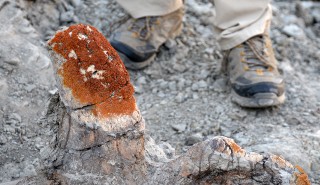
Vibrant orange-coloured lichens are helping scientists discover dinosaur fossils in Canada, according to a new study published today [3 November] in Current Biology.

An international team of palaeontologists and remote sensing scientists have made an exciting discovery at UNESCO World Heritage Site Dinosaur Provincial Park, in Alberta. They have found that certain lichen species preferentially colonise exposed dinosaur bones, creating distinctive spectral signatures that can be detected from 30 metres above ground using drones.

Dr Brian Pickles, from the University of Reading (UK), and lead author of the paper, said: "This research highlights how modern organisms can help us to find ancient ones.

“It's remarkable to consider that these lichens, essentially miniature ecosystems, are founded upon the remains of dinosaurs that died over 75 million years ago. Using drone technology to detect the spectral signatures of the lichens could potentially revolutionise how palaeontologists search for fossils."

The team found that the two lichen species – Rusavskia elegans and Xanthomendoza trachyphylla – colonised as much as 50% of exposed fossil bones but less than 1% of surrounding rock fragments. This likely occurs because dinosaur bones provide the alkaline, calcareous, and porous substrates these lichens favour. 
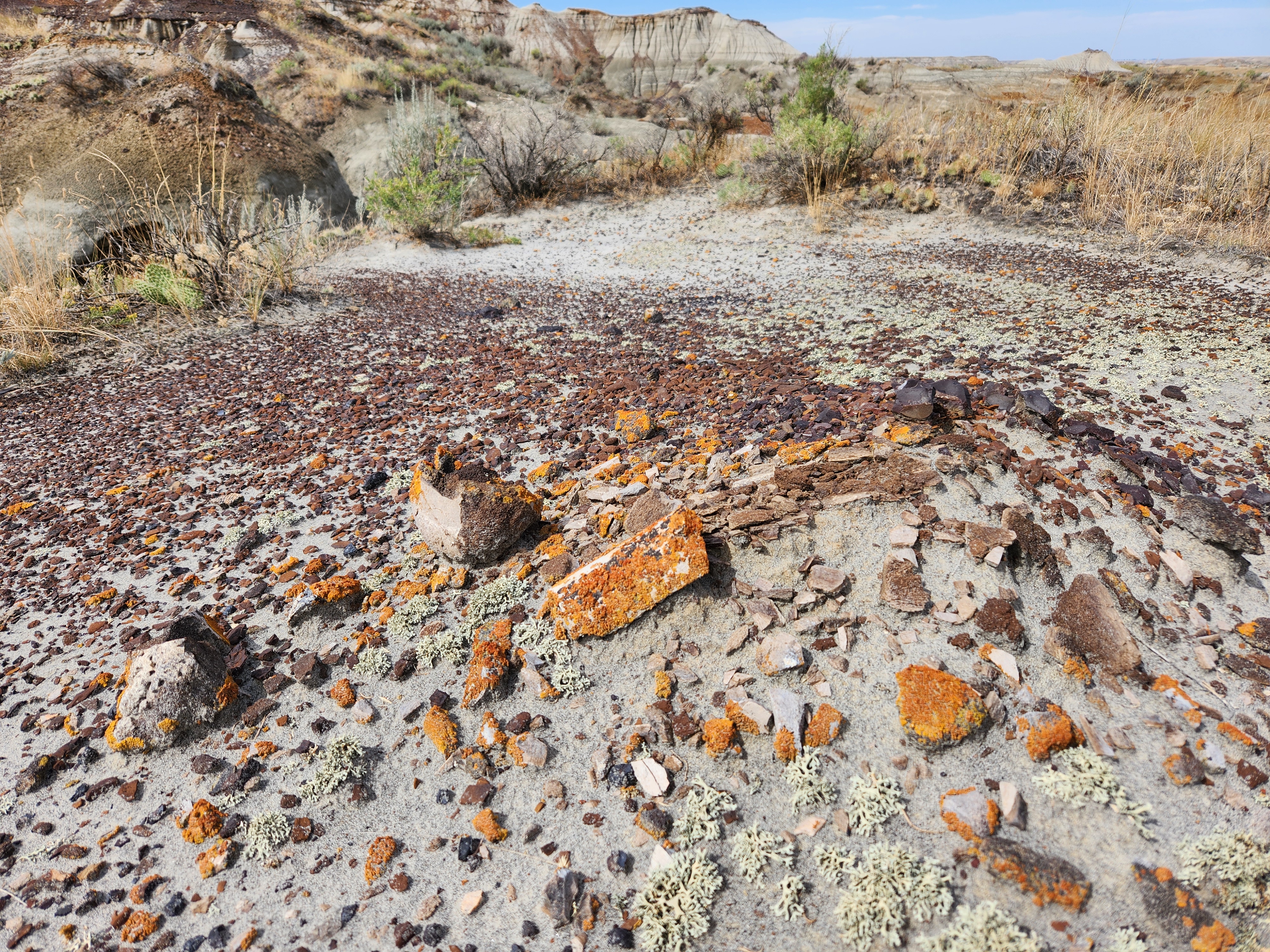
Dr Caleb Brown, from the Royal Tyrrell Museum of Palaeontology (Canada), said: “This pattern of lichen growing preferentially on fossil bone has been noted for decades, but never quantified until now. When first encountering high concentrations of exposed fossil bone like bonebeds, it is often the ‘meadow’ of orange lichen that is noticed first, not the bones themselves.” 

Using Remotely Piloted Aircraft Systems (drones) with specialised sensors, the team successfully identified lichen-colonised fossils from aerial images with 2.5cm pixel resolution. The lichens exhibit distinct spectral properties, showing lower reflectance in blue wavelengths and higher reflectance in infrared regions.

The method can offer significant advantages for palaeontological prospecting, particularly in remote terrain where traditional ground surveys are challenging. The approach could accelerate fossil discovery while reducing field costs and environmental impact.

The research builds on decades of anecdotal observations by palaeontologists. In 1980, palaeontologist Darren H. Tanke speculated that the orange pigmentation of the lichen on Centrosaurus bones might be detectable by satellites – a prediction that seems closer than ever now that they can be found using airborne drone technology.

Dr Derek Peddle, part of the remote sensing team from the University of Lethbridge (Canada), said: "This drone study lays the groundwork for mapping much larger areas using aircraft and satellites. The new lichen indicators we've developed will help us find fossils across vast landscapes. It's exciting to combine our imaging technology with this international team's expertise to advance dinosaur discovery through remote sensing of lichen."

The team emphasises that the method works well in semi-arid environments like the Canadian Badlands, where the specific lichen species thrive and bones remain exposed long enough for colonisation. They intend to explore the broader extent of this association in their future work.


Brian J. Pickles, Caleb M. Brown, Sean Herridge-Berry, Cameron R. Martin, Melissa Dergousoff, Teri Gilmar, Phil R. Bell, Derek R. Peddle. Remote sensing of lichens with drones for detecting dinosaur bones

https://doi.org/10.1016/j.cub.2025.09.036

Loading additional items please wait....

Main Menu


News from 2025

Contact the press team

Expert spokespeople

Media, demonstrations, and petitions on campus

Connecting Research Blog

Events

Media Enquiries


Journalists can contact the press office at any time.

+44 (0)118 378 5757 (24 hours)

pressoffice@reading.ac.uk

News Archives


News from 2025

News from 2024

News from 2023

News from 2022

News from 2021

News archive 1998-2020

mask
Choose a subject
2025/26
2026/27
Undergraduates
Postgraduates
Undergraduates
Postgraduates

Subjects A-B

  • Agriculture
  • Archaeology
  • Building and Surveying

Subjects C-E

  • Construction Management
  • Consumer Behaviour and Marketing
  • Economics

Subjects F-G

  • Finance
  • Food

Subjects H-M

  • International Foundation Programme (IFP)
  • International Relations
  • Museum Studies

Subjects N-T

  • Politics and International Relations
  • Surveying and Construction Management

Subjects A-C

  • Construction Management and Engineering

Subjects D-G

  • Energy and Environmental Engineering
  • Engineering
  • English Language and Applied Linguistics

Subjects H-P

  • Healthcare
  • Law
  • Linguistics
  • Pharmacy
  • Physician Associate
  • Project Management

Subjects A-B

  • Accounting
  • Acting and Drama
  • Agriculture
  • Ancient History
  • Anthropology
  • Archaeology
  • Architectural Engineering
  • Architecture
  • Art
  • Biochemistry
  • Biological Sciences
  • Biomedical Engineering
  • Biomedical Sciences
  • Bioveterinary Sciences
  • Building and Surveying
  • Business and Management

Subjects C-E

  • Chemistry
  • Classics and Classical Studies
  • Climate Science
  • Computer Science
  • Construction Management
  • Consumer Behaviour and Marketing
  • Creative Writing
  • Criminology
  • Ecology
  • Economics
  • Education
  • Engineering
  • English Language and Applied Linguistics
  • English Literature
  • Environment

Subjects F-G

  • Film & Television
  • Finance
  • Food
  • Foundation programmes
  • French
  • Geography
  • German
  • Graphic Communication and Design

Subjects H-M

  • Healthcare
  • History
  • International Development
  • International Foundation Pathways
  • International Relations
  • Italian
  • Languages and Cultures
  • Law
  • Linguistics
  • Marketing
  • Mathematics
  • Medical Sciences
  • Meteorology and Climate
  • Microbiology
  • Museum Studies

Subjects N-T

  • Nutrition
  • Pharmacology
  • Pharmacy
  • Philosophy
  • Physician Associate Studies
  • Politics and International Relations
  • Psychology
  • Real Estate and Planning
  • Sociology
  • Spanish
  • Speech and Language Therapy
  • Surveying and Construction Management
  • Teaching
  • Theatre & Performance

Subjects U-Z

  • Wildlife Conservation
  • Zoology

Subjects A-C

  • Accounting
  • Agriculture
  • Ancient History
  • Archaeology
  • Architecture
  • Artificial Intelligence
  • Art
  • Biological Sciences
  • Biomedical Sciences
  • Business (Post-Experience)
  • Business and Management (Pre-Experience)
  • Classics
  • Climate Science
  • Computer Science
  • Construction Management and Engineering
  • Consumer Behaviour
  • Creative Enterprise

Subjects D-G

  • Data Science
  • Dietetics
  • Digital Business
  • Ecology
  • Economics
  • Education
  • Energy and Environmental Engineering
  • Engineering
  • English Language and Applied Linguistics
  • English Literature
  • Environmental Sciences
  • Film, Theatre and Television
  • Finance
  • Food and Nutritional Sciences
  • Geography and Environmental Science
  • Graphic Design

Subjects H-P

  • Healthcare
  • History
  • Information Technology
  • International Development and Applied Economics
  • Law
  • Linguistics
  • Management
  • Marketing
  • Meteorology and Climate
  • Microbiology
  • Nutrition
  • Pharmacy
  • Philosophy
  • Physician Associate
  • Politics and International Relations
  • Project Management
  • Psychology
  • Public Policy

Subjects Q-Z

  • Real Estate and Planning
  • Social Policy
  • Speech and Language Therapy
  • Strategic Studies
  • Teacher training
  • Theatre
  • Typography and Graphic Communication
  • War and Peace Studies
  • Zoology
  • Charitable Status
  • Accessibility
  • Privacy Policy
  • Cookie preferences
  • Terms of use
  • Sitemap

© University of Reading