
  • Schools and departments
  • Henley Business School
  • University of Reading Malaysia
  • Applicants
  • Student
  • Staff
  • Alumni
  • Local Community
Show/Hide navigation
University of Reading University of Reading
Mobile search categories
  • Study and life
  • Research
  • About us
  • Contact us
  • View courses
  • Home
  • Study and life
    • Study
    • Student life
    • Accommodation
    • Open Days and visiting
    • International students
  • Research
    • Research themes
    • Impact
    • Innovation and partnerships
    • Research environment
    • Get involved
  • About us
    • Business
    • Our global community
    • Local community
    • Visit us
    • Strategy
    • Governance
  • Contact us
  • Applicants
  • Student
  • Staff
  • Alumni
  • Local Community
  • Schools and departments
  • Henley Business School
  • University of Reading Malaysia
  • View courses

Oldest human DNA reveals family network that spanned Europe

12 December 2024
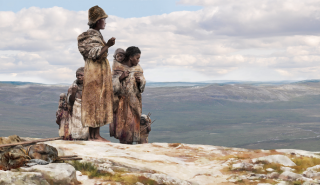
Illustration of the Zlatý kůň/Ranis group by Tom Björklund. Around 45,000 years ago, individuals from Ranis in Germany and Zlatý kůň in Czechia likely traveled together across the open steppe landscapes of Europe. © Tom Björklund for MPI for Evolutionary Anthropology The oldest DNA ever recovered from modern humans shows they arrived as small groups in Europe more than 45,000 years ago and mixed with Neanderthals - but left no descendants.

DNA from bone remains found in Ranis, Germany, revealed some of the individuals were close relatives - including a mother and daughter - while others were more distant cousins. The DNA from a woman’s skull found at Zlatý kůň, Czechia, turned out to be part of the same extended family.

Despite being among the first modern humans in Europe, this family group did not leave any descendants who are alive today. They were part of a pioneer population that eventually died out, making them a ‘lost branch’ of the human family tree.

Published today (Thursday, 12 December) in Nature, the study was led by scientists from the Max Planck Institute for Evolutionary Anthropology in Leipzig (Germany) and involved contributions from researchers at the University of Reading and University of Bristol. Zooarchaeologist Dr Geoff Smith studied more than a thousand bone fragments found at the site of Ranis and Dr Karen Ruebens helped identify them through ancient protein analyses. Dr Ruebens and Dr Smith are now leading a new project at Reading analysing more bone fragments from the region to gain further insights into the diet and lives of these early modern humans and their Neanderthal counterparts.

Dr Karen Ruebens: “It is astounding how these small bone fragments provide such a wealth of data. Ranis turned out to be a real treasure trove. Exceptional DNA preservation gave a unique glimpse into past family groups and their wider connections across Ice Age Europe. It shows an ebb and flow of small human groups during a crucial period of coexistence between Homo sapiens and Neanderthals.”Max Planck Institute

These early Europeans numbered just a few hundred and had dark skin, dark hair, and brown eyes, reflecting their arrival from Africa. One of the most significant findings was that these modern humans and Neanderthals mixed and had children together between 45,000 and 49,000 years ago, but there was no evidence for more recent interbreeding as is the case in other European modern human groups.

Dr Geoff Smith said: “These DNA results are exciting because they show differences in how frequently various groups of early modern humans met with Neanderthals. It is fascinating how these early modern humans were able to adapt to extreme cold conditions but were ultimately unsuccessful and died out.”

Dr Helen Fewlass, an archaeological scientist at the University of Bristol, started working on the Ranis project while based at the Max Planck Institute in Leipzig and has led the radiocarbon dating at the site, including directly dating the human remains analysed in the study.

Dr Helen Fewlass: “The preservation of the ancient bone fragments from Ranis is unprecedented and has given us a huge amount of information about these ancient people. These are the earliest directly dated remains of our species we have yet found in Europe and it’s so exciting to find multiple individuals from one group. The new DNA results give us incredible insights into the lives of this pioneering group.”

Sümer, A.P., Rougier, H., Villalba-Mouco, V. et al. Earliest modern human genomes constrain timing of Neanderthal admixture. Nature (2024). https://doi.org/10.1038/s41586-024-08420-x

Images: 

Top: 

Illustration of the Zlatý kůň/Ranis group by Tom Björklund. Around 45,000 years ago, individuals from Ranis in Germany and Zlatý kůň in Czechia likely traveled together across the open steppe landscapes of Europe. © Tom Björklund for MPI for Evolutionary Anthropology 

Bottom: 

Illustration of Zlatý kůň, who belonged to the same population as the Ranis individuals and was closely related to two of them. © Tom Björklund for MPI for Evolutionary Anthropology 

Loading additional items please wait....

Main Menu


News from 2025

Contact the press team

Expert spokespeople

Media, demonstrations, and petitions on campus

Connecting Research Blog

Events

Media Enquiries


Journalists can contact the press office at any time.

+44 (0)118 378 5757 (24 hours)

pressoffice@reading.ac.uk

News Archives


News from 2025

News from 2024

News from 2023

News from 2022

News from 2021

News archive 1998-2020

mask
Choose a subject
2025/26
2026/27
Undergraduates
Postgraduates
Undergraduates
Postgraduates

Subjects A-B

  • Agriculture
  • Archaeology
  • Building and Surveying

Subjects C-E

  • Construction Management
  • Consumer Behaviour and Marketing
  • Economics

Subjects F-G

  • Finance
  • Food

Subjects H-M

  • International Foundation Programme (IFP)
  • International Relations
  • Museum Studies

Subjects N-T

  • Politics and International Relations
  • Surveying and Construction Management

Subjects A-C

  • Construction Management and Engineering

Subjects D-G

  • Energy and Environmental Engineering
  • Engineering
  • English Language and Applied Linguistics

Subjects H-P

  • Healthcare
  • Law
  • Linguistics
  • Pharmacy
  • Physician Associate
  • Project Management

Subjects A-B

  • Accounting
  • Acting and Drama
  • Agriculture
  • Ancient History
  • Anthropology
  • Archaeology
  • Architectural Engineering
  • Architecture
  • Art
  • Biochemistry
  • Biological Sciences
  • Biomedical Engineering
  • Biomedical Sciences
  • Bioveterinary Sciences
  • Building and Surveying
  • Business and Management

Subjects C-E

  • Chemistry
  • Classics and Classical Studies
  • Climate Science
  • Computer Science
  • Construction Management
  • Consumer Behaviour and Marketing
  • Creative Writing
  • Criminology
  • Ecology
  • Economics
  • Education
  • Engineering
  • English Language and Applied Linguistics
  • English Literature
  • Environment

Subjects F-G

  • Film & Television
  • Finance
  • Food
  • Foundation programmes
  • French
  • Geography
  • German
  • Graphic Communication and Design

Subjects H-M

  • Healthcare
  • History
  • International Development
  • International Foundation Pathways
  • International Relations
  • Italian
  • Languages and Cultures
  • Law
  • Linguistics
  • Marketing
  • Mathematics
  • Medical Sciences
  • Meteorology and Climate
  • Microbiology
  • Museum Studies

Subjects N-T

  • Nutrition
  • Pharmacology
  • Pharmacy
  • Philosophy
  • Physician Associate Studies
  • Politics and International Relations
  • Psychology
  • Real Estate and Planning
  • Sociology
  • Spanish
  • Speech and Language Therapy
  • Surveying and Construction Management
  • Teaching
  • Theatre & Performance

Subjects U-Z

  • Wildlife Conservation
  • Zoology

Subjects A-C

  • Accounting
  • Agriculture
  • Ancient History
  • Archaeology
  • Architecture
  • Artificial Intelligence
  • Art
  • Biological Sciences
  • Biomedical Sciences
  • Business (Post-Experience)
  • Business and Management (Pre-Experience)
  • Classics
  • Climate Science
  • Computer Science
  • Construction Management and Engineering
  • Consumer Behaviour
  • Creative Enterprise

Subjects D-G

  • Data Science
  • Dietetics
  • Digital Business
  • Ecology
  • Economics
  • Education
  • Energy and Environmental Engineering
  • Engineering
  • English Language and Applied Linguistics
  • English Literature
  • Environmental Sciences
  • Film, Theatre and Television
  • Finance
  • Food and Nutritional Sciences
  • Geography and Environmental Science
  • Graphic Design

Subjects H-P

  • Healthcare
  • History
  • Information Technology
  • International Development and Applied Economics
  • Law
  • Linguistics
  • Management
  • Marketing
  • Meteorology and Climate
  • Microbiology
  • Nutrition
  • Pharmacy
  • Philosophy
  • Physician Associate
  • Politics and International Relations
  • Project Management
  • Psychology
  • Public Policy

Subjects Q-Z

  • Real Estate and Planning
  • Social Policy
  • Speech and Language Therapy
  • Strategic Studies
  • Teacher training
  • Theatre
  • Typography and Graphic Communication
  • War and Peace Studies
  • Zoology
  • Charitable Status
  • Accessibility
  • Privacy Policy
  • Cookies
  • Terms of use
  • Sitemap

© University of Reading