
Risk Assessment
Risk assessment is the foundation of safe work. Before any activity begins the risk must be assessed, and then reduced to as low as reasonably practicable, by using control measures to prevent and protect against injury or ill-health.
Risk assessment is primarily a mental exercise. The paper work is simply a record of the decision making, which also makes future reviews easier, when the activity changes, or following an incident.
The completed assessment then provides the basis for training the safe working practices.
Risk Assessment - It's Your Safety Management Plan!
What are we trying to prevent
- Accidents causing injury or death
- Near misses (because they could cause injury if they happen again)
- Work-related ill-health
- Stress related ill health / mental health problems
- Damage to equipment and the environment
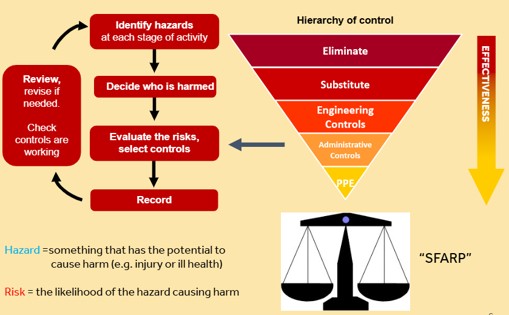
The five-steps of Risk Assessment
Carrying out a risk assessment is straight forward. Break down the activity into the main steps, identify the hazards at each step and consider who could be harmed. Remember to think about employees and non-employees (students, visitors, maintenance workers, disabled or young workers, and expectant mothers where relevant).
When selecting the controls, follow the hierarchy of control and ensure risks are reduced so far as reasonably practical (SFARP). This means balancing the level of risk against the time, cost, and effort needed to reduce it, without applying measures that are grossly disproportionate to the risk.
The assessment should consider the work environment and location, the equipment and substances involved and the competence and capability of those carrying out the work.
Watch this handy 2-minute video from the Health & Safety Executive (HSE)
Who should risk assess and what forms to use
The manager, researcher, or supervisor responsible for the activity is responsible for the risk assessment, as they are best placed to understand the activity, equipment, substances and the people involved. Please record the assessment on the University template forms found at the bottom of this webpage.
Need advice and help?
Need more competency on Risk Assessment?
- H&SS has e-learning or in a class room risk assessment courses. Visit our training page
- The University Safety Policy on risk assessing CoP-4 includes a step-by step guide
- Watch the 2-minute HSE video above
Need more help with understanding the hazards and risks?
- Talk to your peers who are familiar with the workspace, the equipment and substances to better understand the hazards and risks
- Take a look at our occupational exposure webpages for hazardous substance, noise, vibration
- Take a look at ourBiosafety and GM webpages for lab working
- Consult the University hazard and activities specific H&S policies for more topics
- Contact your local H&S coordinator for advice – there’s a network of local support
- Speak with the H&S Services professional advisory team
List of RA forms as links
General
- Risk Assessment Form RA1 - for simple hazards or tasks
- UoR Project risk assessment form RA2- for more complex tasks or projects
- Risk Assessment Log – for cataloguing and managing risk assessing
Hazard Specific
- Combined COSHH and risk assessment form
- COSHH CRA1 form
- Events Risk Assessment
- Expectant mothers risk assessment form
- GM Project Risk Assessment
- Laser Risk Assessment Form RA2L
- Manual Handling Risk assessment form MH2
- Risk assessment for Incidental exposure to hazardous biological agents
- TRA1 - International Travel Risk Assessment
- TRA2 Off Campus UK Business Travel Risk Assessment (Non-fieldwork)
- Meetings Generic Covid19 Risk Assessment August 2021
- Teaching Generic Covid19 Risk Assessment August 2021

- +44 (0)118 378 8888

- safety@reading.ac.uk

-
University of Reading
Health and Safety Services
Whiteknights House (W027)
Room G23
Shinfield Road
Whiteknights
Reading
RG6 6UR
-