Mobile phones are one of the most common technologies on Earth with an estimated 70% of the global populations having access to a mobile. These contain geological resources including metals and minerals to power communication, information, navigation, and entertainment Apps worldwide. Smartphones can contain up to 60 different metals so provide an opportunity to investigate how different geological resources are sourced and used in this ubiquitous technology. Most of us learn by doing so seeing and handling the raw materials from our extensive collections of minerals and rocks makes our teaching, outreach and research more memorable and meaningful. Discussing the origins of the materials in everyday objects such as phones is important. However, it is also vital to consider the environmental impacts as well as the social and economic implications of resource extraction and processing on local and global communities.
Some geological resources are regarded as ‘Critical minerals’ - non-fuel raw materials essential to modern economic, technological, and defence industries that are at high risks of supply chain disruption.
Read UK 2024 criticality assessment OR/24/059 for more.
Lithium (Li) in the phone battery. Atomic number 3.
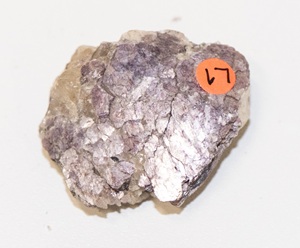
Lithium is a low density but reactive metal. Around 80% of mined lithium is used in batteries.
Lithium can be extracted from igneous rocks where the lithium-bearing minerals such as spodumene [Li,Al,Si2O6], petalite [Li,Al,Si4O10] and lepidolite [K(Li,Al)3(Al,Si,Rb)4O10(F,OH)2], are extracted and refined. The top three producers of lithium are Australia Chile and China. This is the major process of lithium extraction in Australia. However, most lithium comes from brines which have naturally concentrated lithium carbonates which have leached out of volcanic and igneous rocks. These brines are pumped into evaporation ponds where the minerals become concentrated to as much as 6,000 parts per million. Chile is a major source of lithium brines in the Atacama Desert which has very low rainfall and high evaporation rates. However, this process uses large amounts of water which is a serious environmental concern in this water-stressed area.
Lithium is a UK critical mineral. Exploration and development to secure a UK supply of lithium is currently being explored by Cornish Lithium including direct extraction of lithium from minerals in the granites and associated brines in Cornwall. GEL have recently started to source geothermal energy and extract lithium from the brines.
See Mineral profile: Lithium for more.
Cobalt (Co) in the phone battery. Atomic number 27.
Cobalt is used in phone batteries cathodes as it provides high energy density and helps to manage heat reducing the risk of fire as well as allowing fast charging reducing the amount the battery deteriorates over time.
Around 75% of global cobalt supply is from the Democratic Republic of Congo (DRC) where it is found in metal-rich sediment deposits that formed in the Neoproterozoic (1 billion to 538.8 million years ago). The metals were concentrated in fluids in an ancient basin and then precipitated in the sediments during their burial history
There are major issues with this supply due to informal (artisanal) mining which is often unsafe resulting in injury and deaths and exploitation of workers including child labour. Many companies including BASF, Samsung and Glencore as well as electric vehicle manufactures have committed to schemes such as the Responsible Cobalt Initiative and Cobalt for Development. Companies such as Apple sourced phone batteries from suppliers such as CongoDongFang but as of 2026 are now committed to using only recycled cobalt in its products.
See more on Cobalt Institute.
Copper (Cu) in the phone circuit board. Atomic Number 29.
Copper is a major component in circuit boards as it is very good at conducting electricity and heat and can be drawn into thin wires. Major sources of copper ores are Chile, Peru and China.
Copper can occur in its pure form as a ‘native’ element. However, most is found where magma found in minerals such as chalcopyrite and chalcocite, Porphyry copper deposits are the main sources of copper ores. These formed near subduction zones where two tectonic plates collided. Water-rich magma form at depth in subduction zones cause hydrothermal alteration of the surrounding rock concentrating copper and other minerals such as gold and molybdenum. These metal-rich fluids then migrated upwards to cool and precipitate their dissolved minerals nearer the surface. Most copper is extracted through large open-pit mines which can result in habitat loss, changes to local hydrology, low-level seismicity, dust and noise.
Globally around 30% of global copper is recycled which reduces the need for primary resource extraction.
Gold (Au) in the phone circuit board. Atomic number 79.
Gold is ideal for protecting electrical copper components because it conducts electricity well and does not corrode. Thin gold wires are used inside computer chips to produce circuits.
Gold occurs in its pure form as a ‘native’ element. Gold occurs in hydrothermal veins deposited from metal-rich fluids near igneous intrusions. It is also found as ‘placer’ deposits where flakes and nuggets have been eroded from veins and then transported downstream and deposited. The main sources of gold are China, Russia and Australia. Historically most gold was from South Africa.
Around 20% of gold extracted is by an estimated 16 million ‘artisanal’ miners who can be subject to exploitation and abuse. In addition dangerous working conditions including use of chemicals such as cyanide and mercury in the extraction of this precious metal causes severe health and environmental issues. In 2019 the Responsible Gold Mining Principles were launched by The World Gold Council seeking to improve the supply chain and set clear expectations for consumers and investors.
See more at gold.org.
Silicon (Si) in the phone screen and circuit board. Atomic number 14.
Silicon makes up over 27% of the Earth’s crust by weight and is found in sand, quartz, amethyst, agate, flint and opal. Silica is the major component in mobile phone screens. Silica (silicon dioxide/SiO₂) is the main component in mobile phone screens, made from high-purity sand and processed into thin, strengthened glass that protects components while maintaining touch sensitivity.
Hyper-pure silicon is also used as a semiconductor in solid-state devices including phones. in the computer and microelectronics industries. The silicon is doped with tiny amounts of boron, gallium, phosphorus or arsenic to control its electrical properties. Taiwan is the global centre of the semiconductor industry producing over 90% of the world's advanced AI chips as of 2026.
Rare Earth elements such as Neodynium (Nd). Atomic number 60
Mobile phones contain 8 to 10 rare earth elements (REEs)—primarily neodymium, dysprosium, terbium, praseodymium, gadolinium, lanthanum, yttrium, and europium. These elements enable miniaturization and form components like micro-magnets for speakers, colourful and clear screens and resistance to scratches.
The Rare Earth Elements (REEs) are not that rare in the crust – some at 20-43 parts per million (which is more than the concentration of lithium), but they are not often concentrated by geological processes into ores that are economic to extract. Rare Earth Elements are most commonly concentrated in carbonatites which are igneous rocks with a high proportion of calcium carbonate. They are also found in sands which have been weathered from igneous rocks.
China supplies over 90% of global demand, notably from mines in Inner Mongolia with other sources from the USA and Australia.
See more about Rare Earth elements.
Aluminium (Al) in the phone casing. Atomic number 13.
Aluminium is a lightweight, silvery metal which is often anodised to increase the thickness of the natural oxide layer on the surface of the metal. It is lightweight, durable, corrosion resistant and can conduct heat away from crucial internal components. Globally around 76% of aluminium is recycled reducing the need for extraction of primary resources.
Bauxite is the main ore of aluminium. Bauxite is a sedimentary rock which contains different minerals but several of these such as gibbsite (Al(OH)3) and boehmite (y-AlO(OH)) are aluminium rich.
Bauxite often occurs in the tropics where there is intense weathering of silicate-rich rocks such as granite and gneiss which allows the aluminium to become concentrated.
See more about Aluminium
What Should I Consider?
• Choose recycled or ethically sources phones – check with your supplier.
• Reuse, donate or recycle old devices – your phone company may recycle old devices.
• Keep your phone for longer if possible