Internal, open access

Training needs

Introduction

One of the fundamental requirements of the Health and Safety at Work etc Act 1974 is that all employees are adequately trained for the work that they carry out. Staff must be provided with sufficient health and safety information, instruction and training to ensure they are aware of the hazards in the workplace and know what safe working procedures to follow to reduce the risk of injury or work-related ill health, to themselves and others. Training is also essential to raise the level of staff and student awareness of University health and safety policies, procedures and practices, and ensure their effective implementation.

Most training is provided 'on-the-job'; health and safety should form an integral part of the ongoing instruction and supervision of staff and students. To supplement local training, a centrally organised programme of health and safety training is provided by the University Health & Safety Services.

Assessing training needs

The health and safety training needs of staff should be assessed on appointment and on an ongoing basis when new tasks and equipment are introduced, or if staff take on a new role with increased health and safety risks or responsibilities. Training needs should also be reviewed as part of the staff development review process.

All Schools and Directorates are required to assess the health and safety risks from their work activities. This risk assessment process should be used to determine the level of staff and student health and safety competence, training and instruction, necessary for each activity, role or project.

It is recommended that the training requirements for each job role are clearly defined so that a training needs matrix can be drawn up. This will enable Heads of units to monitor delivery of essential training to staff, and students as appropriate.

The types of training that should be considered are outlined below.

Induction training

All new staff must be provided with a structured health and safety induction to the workplace and their work.

University New Staff Induction Courses, which include health and safety, are organised by CSTD throughout the year. All new staff should attend one of these sessions; details are available from Centre for Staff Training and Development (CSTD). In addition, new staff must be provided with a local induction by their line manager or supervisor, as soon as possible after they start work. A comprehensive Health and safety induction checklist is available. A local induction checklist is also available from CSTD Induction Support, which includes health and safety items. Both checklists can be tailored to the needs of the individual School or Directorate.

Emergency procedures should be discussed with the new staff member on their first day of work. Students should also be provided with a local health and safety induction when they join their course or research group and when they join their Hall of Residence.

Additional health and safety instruction should be provided at appropriate intervals thereafter, when new hazards are introduced, such as new tasks, equipment, hazardous substances and prior to embarking on research projects, field trips and work placements.

Training for managers and Area Health & Safety Co-ordinators

All managers, supervisors and Area Health & Safety Co-ordinators should attend training on managing health and safety risks. It is essential that they are clear about their responsibilities towards students and staff and how to assess, manage and monitor their health and safety risks.

Our short one-day training course Managing Health and Safety provides managers and Area Health & Safety Co-ordinators with an overview of their role, legal requirements, accident causation, risk assessment and the basic systems required for effective health and safety risk management. Shorter half day briefings are also available for Area Health & Safety Co-ordinators and managers.

NB: If Departments or Schools wish to train a group of staff, courses can be broken down into short modules, delivered at a time and venue to suit you.

Training for staff with other health and safety roles and responsibilities

Other staff with key health and safety responsibilities must attend the relevant training prior to, or as soon as possible after, taking up their health and safety role. In particular, staff taking on the following roles must receive training, either by attendance on a formal course, or on-the-job within their School/Directorate.

  1. School Radiation Protection Supervisors
  2. School Laser Supervisors
  3. Building Managers
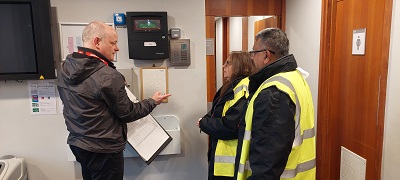
  4. Fire Wardens / Fire Evacuation Officers
  5. First Aiders and appointed persons 
  6. Risk assessors (for general risks; work with hazardous substance - COSHH; manual handling assessors and Display Screen Equipment (DSE) assessors)
  7. Academic Research Supervisors, Principal Investigators, Fieldwork Supervisors and science & engineering school technicians 
  8. Work placement organisers
  9. Social Event Co-ordinators
  10. Food handlers

Risk-specific training

Staff and students must be made aware of the specific health and safety risks associated with their work and work environment. For high-risk activities, training courses are provided, and are outlined in our prospectus. In particular, staff (and students where indicated) engaged in the following types of work must receive training (* indicates mandatory attendace at the appropriate Health and Safety Services course):

  1. Fire Precautions - all staff
  2. Display Screen Equipment (DSE)  - All staff who regularly use computers and display screen equipment (now available on-line through DSEasy)
  3. Safe Manual Handling - All staff who regularly carry out manual handling and lifting of loads ('handlers') *
  4. Laboratory Safety - New laboratory-based staff and postgraduate students *
  5. Asbestos Awareness - All staff whose work may bring them into contact with asbestos containing materials *
  6. Specific laboratory safety sessions appropriate to the risks encountered (e.g. laser safety, radiation safety, genetic modification work, gas safety, use of cryogenics) *

Training is just one ingredient of competence. Staff and students also need to gain experience in applying skills and knowledge, and such experience should be gained under adequate supervision.

Maximum benefit can only be obtained from training if opportunities are provided to apply the newly acquired knowledge and skills to the workplace, as soon as possible after training. Without post-course follow up to implement new learning, the benefits of attending courses can quickly diminish.

Refresher training

Refresher training should be provided where necessary to update skills and knowledge. Recommended refresher periods are given for each course, but as general rule, training should be refreshed every 3 years.

Training records

Health and safety training records must be maintained locally. Each manager (or Area Health and Safety Co-ordinator on their behalf) should ensure that there is a system for keeping records of formal courses attended (internal and external) and on-the-job training. A simple method of doing so is to maintain a training matrix that maps the training received by each individual against the training needs for each job role. In addition, Health and Safety Services now use the TRENT payroll system to keep a central database of staff who have attended courses run by Health and Safety Services. Occupational Health keeps records of staff who have attended their First Aid and Appointed Persons training courses.

Staff can view their training records when they access Employee Self Service on the TRENT system. Staff can also use the self service system to book Health and Safety Services training courses.

Things to do now

Contact Health and Safety Services:

Page navigation


Search Form

A-Z lists